Elena Berger · 12 October 2026
Patterns in Search Behavior Within Specialized Knowledge Repositories: Insights from Log Data Examination
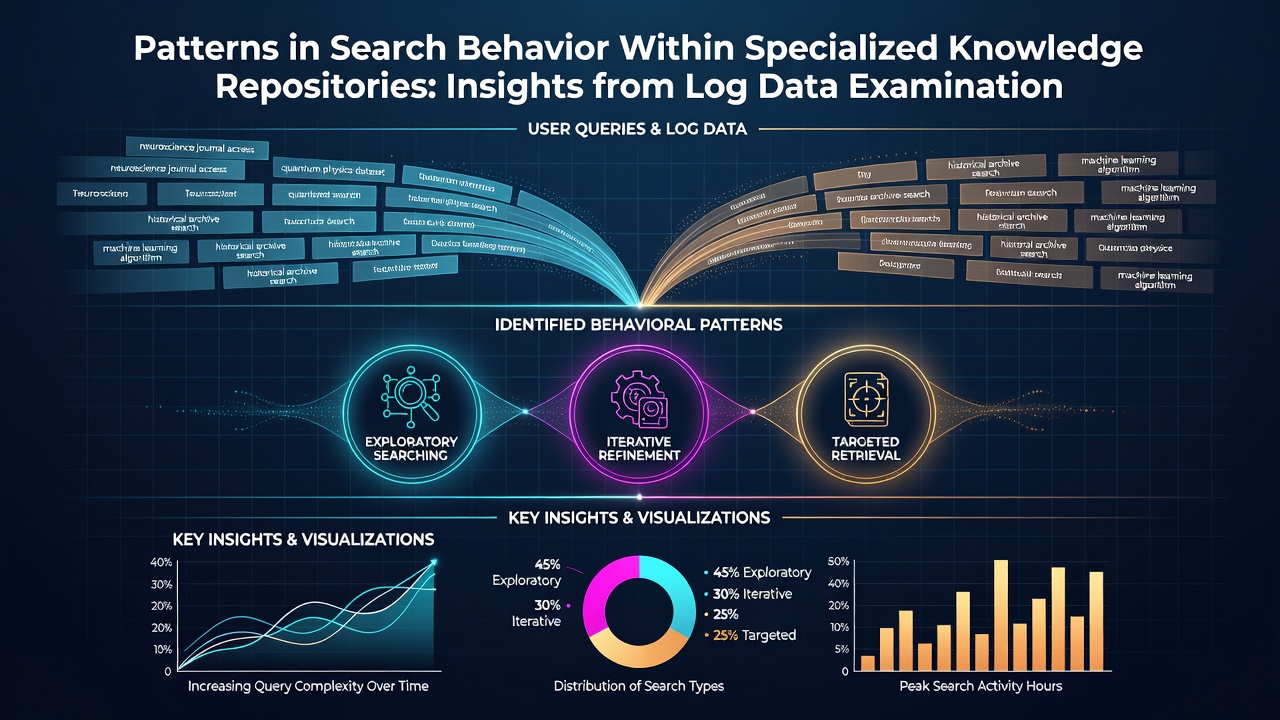
Specialized knowledge repositories maintain detailed logs that record every query, click, and session duration, and analysts examine these records to map how users locate information in fields such as medicine, engineering, and law. Researchers process millions of entries to identify recurring sequences where individuals enter broad terms first, then narrow results through filters or additional keywords. Data collected through October 2026 shows consistent patterns across institutions that operate similar platforms, and these patterns help administrators adjust indexing and interface elements without relying on anecdotal reports.
Log Data Collection and Processing Methods
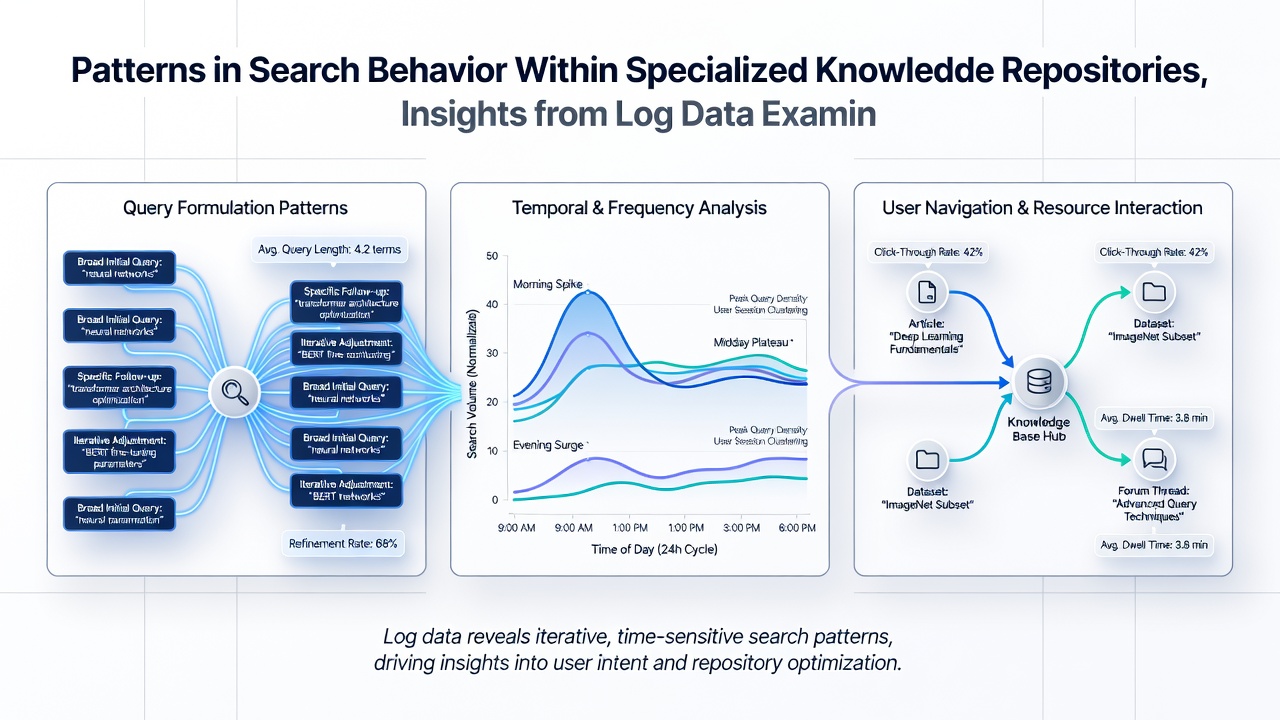
Repository administrators capture timestamps, IP-derived locations, query strings, result rankings, and subsequent clicks whenever a user submits a search. Processing pipelines clean the raw files by removing bot traffic and duplicate entries, then aggregate sessions that span multiple queries within a thirty-minute window. Studies from the University of Melbourne demonstrate that such cleaned datasets reveal clusters of activity around academic calendars, with spikes occurring during exam periods and grant deadlines. Analysts apply sequence mining algorithms to detect common paths, such as an initial keyword search followed by a facet selection on publication date or document type.
Recurring Query Structures Across Domains
Log examinations indicate that users in technical repositories favor noun phrases over full sentences, and they frequently combine domain-specific acronyms with broader descriptors. In medical collections, terms like “randomized controlled trial hypertension” appear more often than conversational phrasing, while engineering logs show heavy use of material codes and standard numbers. Reformulation rates remain high, with approximately forty percent of sessions containing at least one follow-up query that adds or removes a single term. Observers note that result-page clicks concentrate on the first three positions, yet users who reach deeper rankings often export or cite those documents at higher rates according to downstream usage metrics.
Temporal and Geographic Variations
Activity peaks between 9 a.m. and 5 p.m. in the repository’s primary time zone, yet cross-time-zone access creates secondary surges during evening hours in other regions. Logs from October 2026 onward record increased mobile queries during commuting periods, and these sessions tend to feature shorter keywords and higher abandonment before the third result. Geographic analysis shows that researchers in North America and Europe submit comparable volumes of queries containing Boolean operators, whereas contributors from institutions in the Asia-Pacific region more frequently rely on exact-phrase matching. A report issued by the Australian Research Council links these differences to variations in training curricula rather than inherent platform limitations.
Impact of Interface Changes on Behavior
When administrators introduce new filters or autocomplete suggestions, log data registers immediate shifts in query length and click distribution. One repository that added a “related concepts” panel recorded a fifteen percent rise in follow-on queries that reused terms from the panel, while another that simplified its advanced search form saw reduced use of complex Boolean strings. These adjustments also affect session duration, with users completing tasks in fewer steps when suggestions align with common reformulation patterns already present in historical logs. Analysts compare pre- and post-change datasets to quantify retention improvements and to identify which user cohorts adapt most quickly.
Future Directions for Log-Based Research
Continued examination of search logs supports predictive models that forecast query intent and preload likely result sets. Institutions now integrate privacy-preserving aggregation techniques so that individual user identities remain protected while aggregate trends stay accessible for study. Cross-repository collaborations allow comparison of patterns across disciplines, revealing whether medical search behaviors translate to legal or humanities collections. Data gathered through October 2026 already informs prototype interfaces that surface contextual help when logs indicate repeated reformulations within a single session.
Conclusion
Log data examination supplies measurable evidence of how researchers interact with specialized knowledge repositories, from initial keyword entry through result selection and session closure. Patterns extracted from these records guide interface refinements, indexing priorities, and capacity planning without dependence on self-reported surveys. As repositories continue to accumulate entries, analysts maintain focus on reproducible methods that respect user privacy while delivering actionable insights for system improvement.